Whenever we think about successful national teams, especially within an African context, we position it within a World Cup context. Take Cameroon at Italia 90, Senegal 2002, Ghana 2010 and recently Morocco 2022. This makes sense as they punched above their weight against the world’s best so the assumption is that they dominated within Africa. However, this has never been the case as none of them won either the previous or immediate AFCON of their World Cup runs with Senegal 2002 and Ghana 2010 falling short in the final.
Clearly then, we should appreciate the achievements within Africa and in the long and illustrious history of AFCON, one generation stands head and shoulders above the rest as they lifted AFCON thrice on the bounce in arguably the most competitive era of African football. However, at the same time they twice went missing at the world’s stage creating the most curious and underrated side in African history. Egypt 2006-2010.
One could argue against this achievement due to AFCON occurring every two years instead of four. This is obviously not Brazil winning three from four World Cups in twelve years transforming one great team into another. But this 4-year spell is arguably the most competitive in African history. Ivory Coast had their golden generation, Cameroon boasted arguably the greatest African footballer of all time in his pomp, Samuel Eto’o, Ghana were emerging as the side that lit up the 2010 World Cup and Nigeria could call on Jay-Jay Okocha, John Obi Mikel and Nwankwo Kanu.
What Egypt did have, was an Al Ahly core (keeper Essam El-Hadary, Ahmed Faty, Mohamed Aboutrika and later Ahmed Hassan) who dominated African football, winning the CAF Champions League thrice in four seasons between 2004/05-2007/08. But most importantly, under Hassan Shehata, Egypt deployed a tactical system that exposed the then weaknesses of African football.
The 4-4-2 dominated African football and despite the obvious talent within nations like Cameroon, Ghana and the Ivory Coast, their squads boasted strong spines but lacked width. Former Manchester United African scout, Tom Vernon, attributed this to the “Papa Bouba Diop effect” as European teams prioritized developing big and robust African players creating an oversubscription of top-class central players from Mikel to Yaya Toure, Alex Song and Michael Essien.
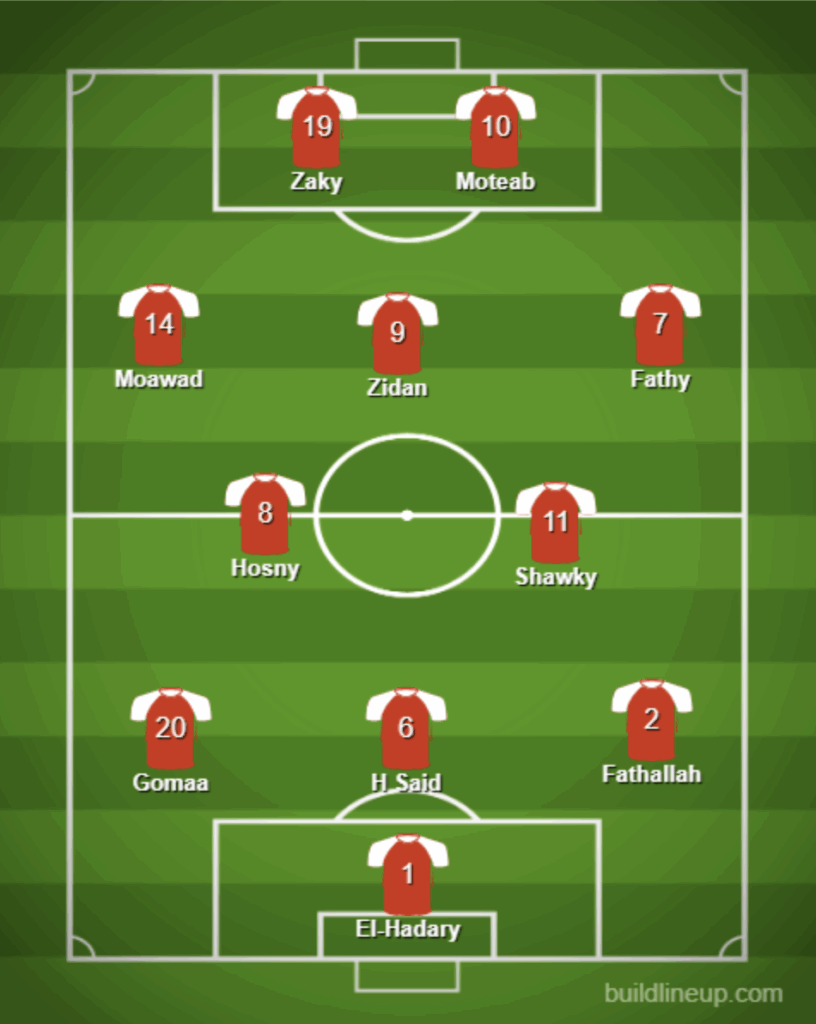
Egypt, meanwhile, deployed a 3-4-1-2 with the midfield three of captain Ahmed Hassan, Hosny Abd Rabo and star man Mohamed Aboutrika dominating possession with their overload. It is no coincidence that Ahmed Hassan (2006 and 2010) and Hosny (2008) were voted Player of the Tournament with Aboutrika winning Man of the Match in the 2008 Final.
Furthermore, their wingbacks Ahmed Fathy and Sayed Moawad exploited the lack of world class wingers by bombing forward with little worry of being exposed.
Home advantage was key in 2006, as it is for the hosts, and 2010 was a great show of resilience without Aboutrika and after failing to qualify for the World Cup. But 2008 was their peak with two dominant displays against Cameroon (4-2) and the Ivory Coast (4-1). Their group stage victory over Cameroon is perhaps their greatest, which is even more impressive considering they were missing their two best players, Hassan and Aboutrika. Mohamed Shawky and Zidan filled in alongside Hosny as the trio overwhelmed Cameroon’s Stéphane Mbia and Jean Makoun. Zidan and Hosny both grabbed braces and Samuel Eto’o’s brace for Cameroon merely softened the score to 3-1 and 4-2 respectively. When the pair met again in the final, Cameroon switched to a 4-2-3-1 which largely stifled Egypt’s midfield but Cameroon created little, and they eventually cracked under Egyptian pressure thanks to an Aboutrika strike.
So how did such a dominant side go missing from the World Cup? I did begin by saying that they missed out on two World Cups, but this is only half true. Their failure to qualify for the 2006 World Cup predates their 2006 success with it being more representative of Egypt’s slump at the start of the 2000s, culminating in an embarrassing group stage exit at AFCON 2004. Their failure in 2010 is what needs to be scrutinized.
But with closer inspection, this is more indicative of how competitive CAF qualification is. Even with nine spots now, stalwarts like Nigeria will miss out. In 2009, it was only five from fifty-three members with one having to win two separate groups of four to advance. Even then, Egypt’s failure came with the finest margins. After progressing from the first group, they finished level on points, goal difference and goal scored with Algeria. Their head-to-head was tied 3-3 and with the away goals rule, Egypt would have qualified, but CAF opted for a one-off tiebreaker in Sudan. In a hostile game, Algeria’s Anther Yahia stunning volley was the difference as Egypt failed to breakdown a dogged Algeria.
Egypt would spectacularly get their revenge with a 4-0 rout at the 2010 AFCON semi-finals as Algeria imploded with three red cards. However, their one failure hid them from the world when it came to Africa as Ghana took the limelight despite Egypt defeating them, 1-0, months earlier to clinch their hattrick of AFCONs.
Who knows how far they would have gone in South Africa. They defeated World Champions Italy at the 2009 Confederations Cup and had they been drawn in the same group as Algeria who were tied with a mediocre England, the USA and Slovenia. The Round of 16 would have been a realistic target. But even in their absence, this was a talented, cohesive and tactically astute side that dominated African football. They may not be lumped in the same bracket as Cameroon 1990, Senegal 2002, Ghana 2010 and Morocco 2022 but put them in a mini-league and any iterations of Egypt would finish near the top.