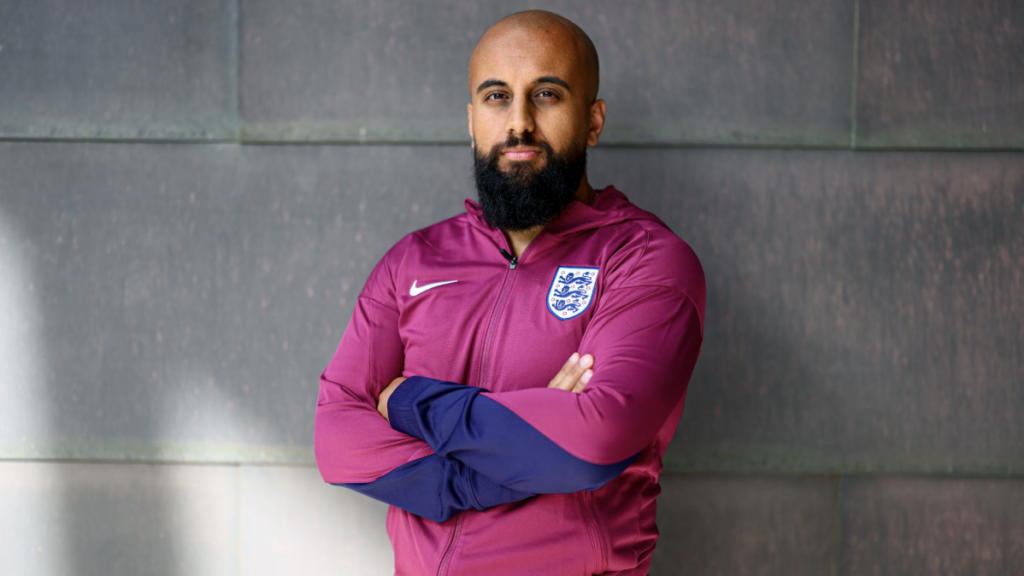
It’s 8:00 am on a chilly May Sunday morning at Woughton on the Green, and I’m helping the MK Don’s Under 13 coach, Hassan Mir (better known as Hass), set up the pitch for their final friendly of the season.
I first met Hass the previous winter at St. George’s Park whilst he underwent a session of the FA’s Mentee Development Program. This is a season-long placement for coaches looking to break into the professional game, and Hass was fortunate to break into the 2025/26 cohort.
I was paired with Hass as part of the initiative’s partnership with BCOMS to help build their brands, and so far, we have produced an episode on the “Football is Played with the Head” podcast. He came off as incredibly articulate and knowledgeable on matters ranging from football to faith.
Now on the pitch, the first thing that stood out was his relationship with the players.
Our pre-match press conference was consistently being interrupted by his players walking in and deliberately greeting him before heading into the changing room.
Julian Naglesmann is attributed with the quote that coaching is “seventy per cent social competence.” It’s probably more so with youth-team football, and it was very easy to see that the players bought into his ideals.
Leading up to the game, this was his main objective.
“The key when I was planning it was where I needed to expose certain players. So what players need is exposure in certain positions to get different outcomes. For example, my left-sided centre back needs more repetition of opening it up on his right foot, so I play him right back. Or if the left-sided eight needs more repetition of playing off one-touch, then I’d put him as the pivot—little things like that, where you can then adjust.”
On an individual level, his main area of improvement as a coach was the development of his players as decision-makers.
“I think a lot of my interventions is a lot me-driven. If we want them to be decision makers on the pitch, then they need to be decision makers off it as well. So, they need to be brave in asking questions, knowing that you know the answer, get their opinion on board, allowing them to express that opinion and seeing if it works. So, then it allows them to get the soft skills they need to then become decision makers off the pitch and on it.”
The game itself was a comfortable 7-2 victory, and watching on from the sidelines, it was clear to see that the main objective was on the player’s versatility in different positions. It was divided into quarters, and after each one, Hass would radically change the positioning of each player whilst maintaining the overall 4-3-3 shape.
Personally, I thought his objective worked, as, despite the result, the players looked to be sufficiently tested by the different questions being asked by their unfamiliar positions. However, Hass did point out a few key areas of improvement upon reflection.
“In terms of the outcome of control, which I set the boys at the beginning, where I said today’s a game where I want to see you take control of the game. I think they did ok. In moments where they sustained pressure higher up the pitch to create those moments to play, I just don’t think we did that enough. This isn’t a bad thing, don’t get me wrong, and it isn’t the end of the world per se. Now it’s just the finer details.”
In terms of his individual performance, what worked was his consistency in messaging, which brought a sense of security among the players, no matter what the score.
“I don’t think my message changed. Whether we scored four in that quarter or didn’t score any and conceded. It was still doing the right things in the right moments to give the players the best opportunity to learn and develop. I think that’s probably my biggest thing. It’s recognizing that consistency in how far that would go in terms of their development. And I think that’s why many players resonate so well with me, because there are no surprises. They know what to expect. They know my levels, but there’s a level of consistency throughout, and then they are not afraid to make mistakes as long as their intentions are right to keep doing what’s asked of them.”
However, there is still a need to transform this consistency into creating players comfortable in becoming decision-makers.
“Considering the opposition, it should have allowed me to go more player-specific or player-oriented approach. So that’s what I would’ve changed probably in terms of the way I delivered the message, making it more player-oriented in terms of coach-led.”
That being said, there has been a development in the players’ leadership qualities, which Hass is most proud of as they broke into eleven-a-side football.
“The biggest thing I’ve enjoyed about watching this group is their psychological resilience. Compared to the start of the season, where they struggled, there didn’t seem to be many people who could lead by example. I think today it really epitomized that by having four/five Under-12s playing up and the 13s really got on them and supported them through that, which at the start of the season they wouldn’t have done that.”
A few days after our encounter, Hass then travelled to Lisbon for a study visit to S.L. Benfica’s youth teams as part of the Mentorship Program. Later in May, he would attend one more workshop in Wembley before graduating in the summer.
As he commends the improvements of the boys throughout this year. It is exciting to see his own improvements as a coach, moving on from the Mentorship Program and into next season as he continues his journey within youth team coaching.
Faniki Deche