What was meant to be a proud milestone in my young journalism career quickly turned into a painful reminder of the challenges that persist in the industry. After receiving my second media accreditation to cover Arsenal v Crystal Palace, an experience that should have marked a moment of pride and progress. I found myself subjected to a barrage of racial abuse on X, formerly Twitter.
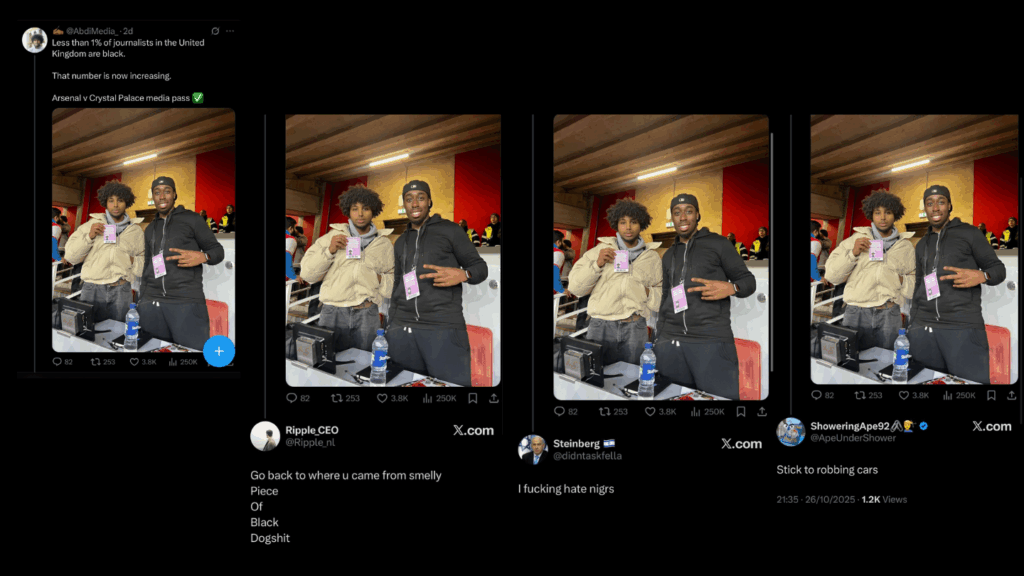
The occasion, which began with excitement and celebration, particularly as I sat in the press box alongside my BCOMS colleague Kwame, was intended to symbolise the diversity and inclusion that BCOMS strives to champion within sports media.
The numbers tell a difficult truth about the state of sports media today. According to the Reuters Institute, nine out of ten journalists in the UK come from a white background, while the share of black journalists has only risen from 0.3 per cent to 1.3 per cent, and the proportion of asian journalists has shown no significant change.
Gender inequality is just as stark. A study by Deirdre O’Neill, Senior Lecturer in Media and Journalism at the University of Huddersfield, found that only 1.8 per cent of sports stories in the national UK press are written by women. Together, these figures highlight how much of the industry still lacks meaningful representation.
Those who do make it often describe similar experiences. Moments of pride overshadowed by exclusion, stereotyping or even hostility. Their voices reveal the barriers that numbers alone cannot explain.
Mayowa Quadri, Head of Brand for Versus, highlighted both the challenges and the strengths that come with being a minority in the industry. He said, “We often only see some representation on the field of play. We hardly see it off that. Representation means that players speak to and hear from people who understand them. As a minority in this field, I have faced obstacles such as being judged before I had even worked or pigeonholed into one thing.”
Grant Igbokwe, content creator for Football Beyond Borders, emphasised how visibility can shape ambition. “Black and brown people are massively underrepresented in media, let alone women. Having people that look like you, people that come from a similar background, can be super motivating and refreshing.”
Abdus Salam, an assistant producer for the Premier League, offered a wider perspective covering both the pitch and the press box. He said, “Representation is vital within the sports media space. When you look at the pitch, you see diversity and people from different backgrounds. So why cannot that be reflected in the landscape where people talk about and cover these sports?”
Back in 2020, during the height of the Black Lives Matter movement in football, taking the knee was widely praised as a meaningful gesture of solidarity. But, Wilfried Zaha challenged that narrative when he refused to take the knee. At first, it felt confusing and unusual within football culture. Then it became clear why his decision made sense. Zaha is a black footballer who has experienced racial abuse firsthand and he was making a simple, but powerful point. Gestures mean very little if they are not accompanied by real change.
‘Representation Matters: Navigating Race, Gender and Opportunity in Sports Media’
Together, the experiences of Mayowa, Grant, Abdus and underline a central truth. Representation is not just about presence, it is about being seen, heard and understood. It is about creating opportunities and ensuring that the industry recognises and nurtures talent from every community. While progress has been made, much more is needed to ensure that sports media truly reflects the diversity of the game itself.
Women in sports
Ella Frederick, a junior assistant producer at Sky Sports Football, reflected on how representation fuels her drive. She said, “Representation is huge, especially as a black woman, it drives me more. Representation allows you to form allyships. That is why I am glad organisations like BCOMS exist because it forges friendships and networks not just for now, but forever. I feel incredibly lucky to know so many amazing black women in the industry who remind me that I belong here and keep me going, even when things feel challenging.”
BCOMS student Ruqayyah Fombo, who is just beginning her journey, spoke about the importance of seeing people like her in the industry. She said, “Representation is really important in sports media. Members of sports media are responsible for interviewing athletes who come from a diverse set of backgrounds. As a black muslim woman who aspires to work in sports media one day, I have only recently begun to believe that there is a place for me in the industry.”
Sky Sports recently launched Halo, a platform for women’s sport. The intention behind it is clear and admirable, giving women’s sport more visibility. However, the execution has fallen short. Creating a separate site rather than featuring coverage on the main Sky Sports platform can make women’s sport feel like an “add-on” rather than fully integrated into the wider sporting conversation.
The branding, including “matcha” and “football girlies” and pastel pinks, was intended to create a fresh identity, but it risks reinforcing outdated stereotypes and does not fully reflect the professionalism and seriousness of women’s sport.
Halo shows that good intentions are not enough. Visibility and integration are key and women’s sport deserves to be presented as an essential and equal part of the sporting landscape.
Representation in sport, whether in media, as content creators or producers, is about inclusion, visibility and opportunity. It is about creating an environment where talent is nurtured, voices are heard and coverage reflects the diversity of the game itself. Progress has been made, but the experiences of these journalists, content creators and producers, along with the lessons from Halo, show that there is still much work to be done.